Featured Post

Ultra violet

UV is a form of radiation generated by atomic transitions in chemical reactions such as those present in the Sun and in man-made equipment s...

Showing posts with label history. Show all posts

Thursday, January 21, 2010

Electronic Warfare in WW1- The Telegraph War (5)


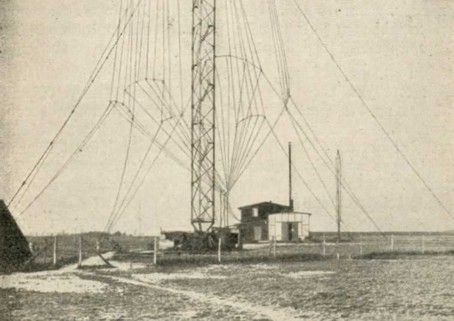
Powerful stations were established in Germany the main one being a Nauen.. When war broke out and Germany lost its cable links it still retained a world wide network of wireless stations. Moreover by wirelessing a German station in the United States messages could then be put on an international telegraph service there. This was how many messages to and from Mexico and South America were transmitted. This was facilitated by a strange decision made by President Wilson himself, this was that, whilst to enforce US neutrality, outgoing radio messages would be subject to a Federal censor’s approval (to ensure that they were not of a military nature), there would be no control over telegraph messages carried by cable. Thus a coded message could be received by a German commercial wireless telegraphy service in the USA and then taken to an American cable service for onward transmission to anywhere in the world without any check on its contents.Britain also invested in wireless stations around the world, primarily to service the needs of the Royal Navy.

Saturday, January 16, 2010

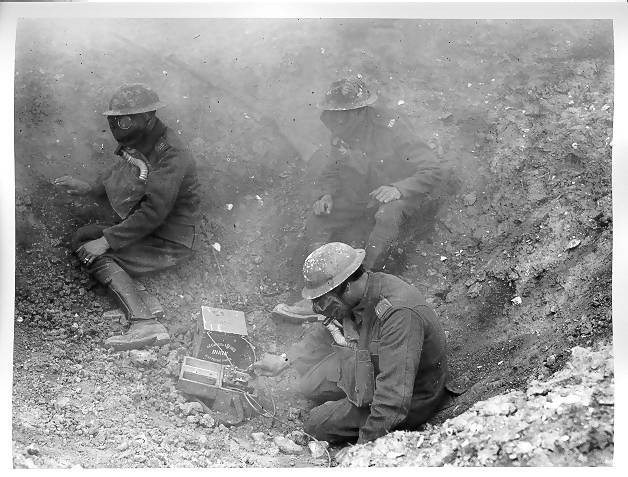
Electronic Warfare in WW1- The Telegraph War (4)


Like all new devices it took time to roll the new system out but it was in fairly widespread use amongst the Allies by the end of the war. More advanced versions of the Fullerphone system were in extensive use in World War Two.
Wireless Wars

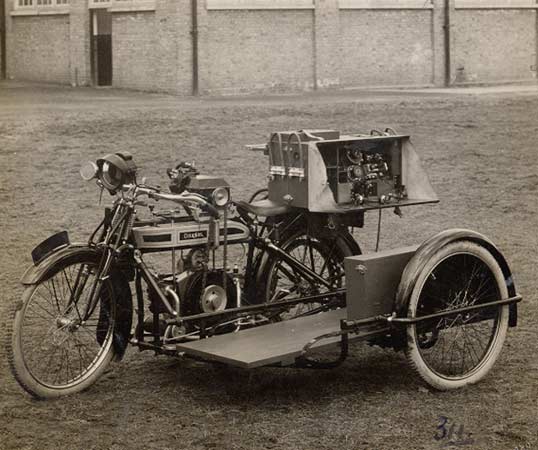
In 1914 the use of wireless was largely restricted to large relatively permanent land installations and ships. The inhibiting factor was both the lack of portability of the equipment itself (particularly the receiving units) and the size of aerial needed to have any sort of effective range. By the end of 1918 wireless sets were in use in the front line, in tanks on wireless trucks, from aircraft and even motorcycle mounted. Right from the beginning wireless played an important strategic role. Germany anticipated the possible loss of its submarine cables if war broke out and invested heavily in installing powerful wireless stations in all its colonies, even the smallest. German commercial companies were ‘encouraged’ to set up subsidiaries with large transmitters and receivers in countries that were likely to be neutral. The United States was the principal country in which this was done and Telefunken established a number of stations there (they also supplied the US Army with wireless equipment).

Picture 1
Motorcycle mounted Marconi set
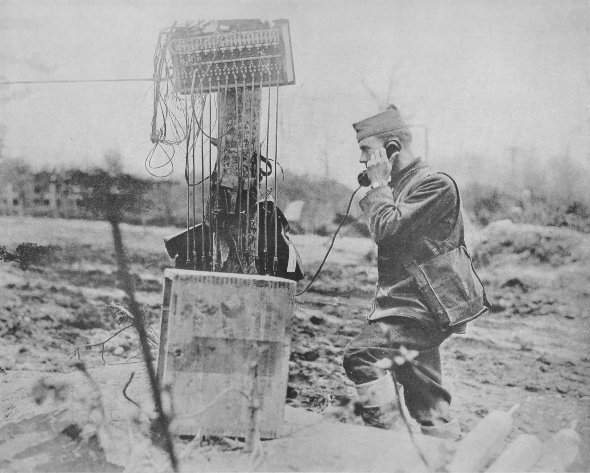
Picture 2 Fullerphone in use

Thursday, January 14, 2010

Electronic Warfare in WW1- The Telegraph War (3)


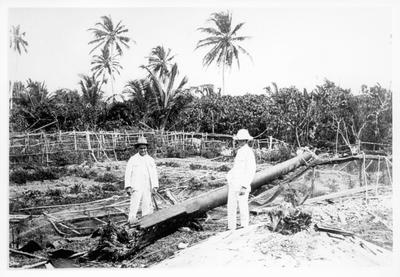
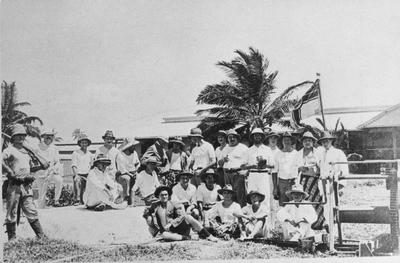
The threat of German raiding parties was not lost on other parts of the World. In Canada troops were despatched to guard telegraph stations on both Pacific and Atlantic coasts. In New Zealand the coastal forts, with their disappearing guns, were manned. However with the destruction of the German squadron at the battle of the Falkland Islands, the loss of the Emden and the fall of the port of Tsientao Germany had no naval force outside European waters that could threaten the international cable network.
Tapping the Telephones.
The Western Front was festooned with the wires of trench and field telephone and telegraph systems. Although the official British Army instruction was to bury these at least a foot and a half this was not always possible in the heat of an action.

Sunday, January 10, 2010

Electronic Warfare in WW1- The Telegraph War (2)


More spectacular was the expansion of the international telegraph network, mainly through the laying of submarine cables (each cable comprising many individual wires). Every major power owned its own commercial network of cables, in time of war these came under either direct government control or close supervision. The technology had also advanced to the point where primitive forms of multiplexer and code compressors were in use to allow a single wire to handle multiple messages. Switching equipment, although fundamentally mechanical, had become complex and expensive. The destruction or damage of an international telegraph station or relay could cause considerable disruption and take a long time to replace (especially if complex equipment had to be transported to it by sea). Such stations thus became important strategic targets in time of war.
Britain with her wide spread empire and trading interests was particularly vulnerable to damage to the cable network, she was, however, well placed to protect her cables and wreak havoc on those of her enemies. Germany had a problem as, for geological reasons, most of her international cables left Europe via the English Channel. As we shall see later she made some alternative arrangements.
On August 4, 1914 Britain opened the telegraph war by cutting the German submarine cable that ran from Borkum in the North Sea to the Spanish island of Tenerife in the South Atlantic. There was a substantial German research station on the coast of Tenerife and there were fears (possibly incorrect) that this was being used as a cover for espionage and potentially for U boat support. As Tenerife lay close to the sea routes that British ships would take to Britain’s West African colonies and South Africa, Winston Churchill (then 1st Lord of the Admiralty) ordered the cutting of the communications link.

Thursday, January 7, 2010

Electronic Warfare in WW1- The Telegraph War


There is a common misconception that electronic warfare began with the Second World War but, even if it was not so labelled, it played a significant part in the First World War at both a strategic and a tactical level.

Both sides relied on complex cable and wireless links for communication and intelligence gathering on an international scale whilst, at the fronts, they maintained a complex web of trench and field telephone lines and exchanges. It has been said that in 1918 that there were probably more military telephones serving the Allied lines on the Western front than there were domestic ‘phones in Britain, America and France. It would therefore be surprising if the Allies and the Central Powers had not attempted to damage each others networks, protect their own, gather intelligence from their opponent’ networks and disseminate misleading information through it.
The Telegraph War

The electric telegraph played an important role as early as the American Civil War and by the 1870s most major armies had telegraph sections that could lay cables and relay messages. In the Franco Prussian War the French were already deploying portable telegraph sets that could be strapped to a soldier’s back. The British Army in the 1880s developed a horse drawn limber system that could lay telegraph cable at the gallop. Almost all armies were still using such equipment in 1918 (although many of the cable laying vehicles were motorised).

From: http://www.blogger.com/post-create.g?blogID=2058111175640698081